Moisture-related flooring failures are expensive, disruptive, and preventable. Whether you’re installing epoxy, urethane cement, polished concrete, or another resinous system, choosing the right concrete moisture test—and understanding the results—is critical. This guide breaks down Calcium Chloride (MVER) vs. In-Situ Relative Humidity (RH) testing, when each is appropriate, and how to interpret the numbers so your floor performs as designed.
What Concrete Moisture Testing Is (and Why It Matters)
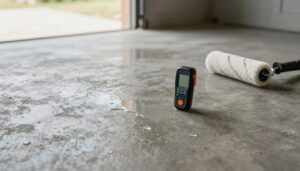
Concrete always contains moisture. Problems arise when excess moisture vapor migrates upward and becomes trapped beneath impermeable coatings, leading to blistering, delamination, and bond failure. Before any installation, a qualified contractor evaluates slab conditions and aligns the test method with the flooring system—especially for high-performance options like epoxy and urethane cement used in demanding environments.
If you’re planning a project, it’s smart to start with a professional assessment through a contractor experienced in commercial and industrial flooring systems like those outlined on Broadleaf’s services overview.
Calcium Chloride Testing (MVER): How It Works
The Calcium Chloride test measures Moisture Vapor Emission Rate (MVER) from the slab surface over 60–72 hours. A pre-weighed dish absorbs vapor; the weight gain is converted to pounds of moisture per 1,000 sq. ft. per 24 hours.
Typical use cases
-
Older specifications that still cite MVER
-
Preliminary screening on existing slabs
Limitations
-
Surface-only snapshot (doesn’t measure internal slab moisture)
-
Sensitive to ambient conditions
-
Less predictive for slabs on grade or with vapor barriers
Because many modern resin systems are less forgiving, MVER alone is often insufficient for long-term performance—particularly for systems like polished concrete flooring that rely on stable moisture conditions.
In-Situ Relative Humidity (RH) Testing: How It Works
RH testing places probes into drilled holes within the slab (typically 40% depth for slabs drying from one side). Sensors measure internal relative humidity, which better reflects the moisture that will equilibrate beneath the finished floor.
Why RH is preferred
-
Measures moisture where it matters—inside the slab
-
Less affected by room conditions
-
Endorsed by ASTM F2170 and most flooring manufacturers
RH testing is the standard for high-performance installations across industrial flooring and commercial environments where failure risk is costly.
Key Differences at a Glance
-
What’s measured:
-
Calcium Chloride → Surface vapor emission
-
RH → Internal slab moisture
-
-
Predictive accuracy:
-
Calcium Chloride → Limited
-
RH → High
-
-
Manufacturer acceptance:
-
Calcium Chloride → Declining
-
RH → Widely required
-
For moisture-sensitive systems—like urethane cement flooring in food processing or metallic flooring in showrooms—RH testing is almost always the safer choice.
How to Read Calcium Chloride Results
Results are reported as lbs/1,000 sq. ft./24 hrs.
-
≤ 3 lbs: Generally acceptable for many coatings (check manufacturer specs)
-
3–5 lbs: Marginal; mitigation or alternate systems may be required
-
> 5 lbs: High risk; expect failures without mitigation
Always cross-check with the specific system being installed, whether that’s a flake flooring system or a quartz flooring system.
How to Read RH Test Results
Results are reported as % Relative Humidity at probe depth.
-
≤ 75–80% RH: Acceptable for many epoxy and coating systems
-
80–90% RH: Limited system options; moisture mitigation may be required
-
> 90% RH: High risk; specialized systems or mitigation mandatory
RH thresholds vary by product. For example, sealed concrete flooring may tolerate different conditions than stained concrete flooring, so system selection matters.
Which Test Should You Use?
In most modern projects, RH testing is the correct choice—especially for:
-
New slabs on grade
-
Commercial and industrial facilities
-
Resinous systems with strict warranties
Calcium Chloride may still be used for legacy specs or as a supplemental data point, but it shouldn’t be the sole decision-maker for critical installations like manufacturing facility flooring or restaurant and food service flooring.
What Happens If Moisture Is Too High?
If results exceed limits, options include:
-
Moisture mitigation systems
-
Switching to moisture-tolerant flooring
-
Adjusting timelines to allow further drying
An experienced contractor can guide the best path forward, often starting with a full evaluation via the FAQ and consultation process outlined on Broadleaf’s FAQ page or coordinating next steps through the contact page.
TL;DR / Key Takeaways
-
RH testing measures internal slab moisture and is the modern standard.
-
Calcium Chloride only measures surface emission and is less predictive.
-
Always match test results to manufacturer requirements for your flooring system.
-
When moisture is high, mitigation or alternate systems can prevent costly failures.
If you’re planning a flooring project and want confidence before installation, reviewing your options with a specialist in commercial and industrial flooring can save time, money, and headaches.