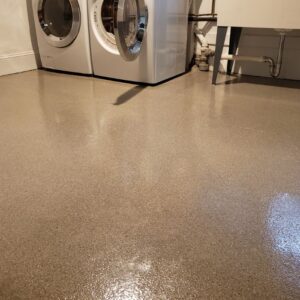
Warehouse floors take a beating.
Forklifts, pallet jacks, heavy equipment, rolling carts, foot traffic, dropped materials, spills, and constant loading and unloading can put enormous demands on a concrete surface. Choosing the wrong flooring system can lead to premature wear, difficult maintenance, safety concerns, and disruptions that interfere with daily operations.
The challenge is that there isn’t one flooring system that’s automatically best for every warehouse.
The right solution depends on how the facility operates, the condition of the existing concrete, the type of traffic the floor experiences, exposure to chemicals or moisture, maintenance requirements, and other performance priorities.
At Broadleaf, we help commercial and industrial facilities evaluate these factors before selecting a flooring system. Here’s what facility owners and managers should consider when comparing warehouse flooring options.
What Should You Look for in Warehouse Flooring?
Before comparing specific systems, start with the demands placed on the floor.
A light-storage warehouse and a high-volume distribution facility may have very different requirements. The same is true for a warehouse connected to manufacturing, food processing, shipping, or other specialized operations.
Important considerations can include:
- Forklift and vehicle traffic
- Impact and abrasion
- Chemical exposure
- Moisture
- Cleaning requirements
- Slip resistance
- Appearance
- Safety markings
- Existing concrete condition
- Installation downtime
- Long-term maintenance
Broadleaf provides commercial and industrial flooring solutions designed around the conditions found in demanding facilities rather than taking a one-system-fits-all approach.
Epoxy Flooring for Warehouses
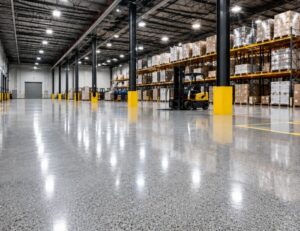
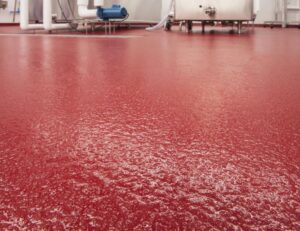
Epoxy is one of the most recognizable options for commercial and industrial concrete floors.
An epoxy system can create a durable surface capable of handling demanding environments when the substrate is properly prepared and the system is selected for the application.
That makes epoxy worth considering in warehouses where durability, cleanability, appearance, and resistance to everyday wear are important.
However, the specific environment matters.
A warehouse with heavy forklift traffic, chemical exposure, or specialized production requirements may need a different system or system configuration than a relatively light-duty storage facility.
Broadleaf offers industrial flooring solutions for demanding environments as well as dedicated industrial epoxy flooring in Chicago.
How Long Can Commercial Epoxy Flooring Last?
There’s no universal lifespan that applies to every epoxy floor.
Surface preparation, system selection, installation quality, traffic, chemical exposure, maintenance, and the condition of the underlying concrete can all affect performance.
Our guide to how long epoxy flooring lasts in commercial and industrial spaces explains these factors in greater detail.
For warehouses, the important question isn’t simply whether epoxy is durable. It’s whether the particular system is appropriate for the conditions it will encounter.
Polished Concrete for Warehouse Floors
Polished concrete takes a different approach.
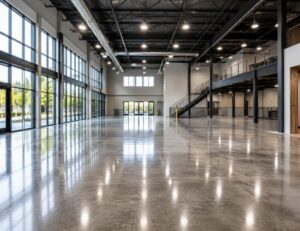
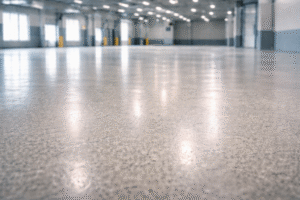
Rather than covering the concrete with a traditional coating system, the existing concrete is mechanically processed to create a refined, durable surface.
For suitable warehouse environments, polished concrete flooring can provide an attractive combination of durability and relatively straightforward maintenance.
It’s particularly worth considering when a facility wants to utilize the existing slab while creating a more finished appearance.
Polished concrete has also become increasingly popular in other commercial settings. Broadleaf’s article on why polished concrete is becoming a top choice for commercial buildings discusses the reasons behind that interest.
Polished concrete isn’t automatically the right answer for every warehouse, however. Chemical exposure, moisture conditions, slip-resistance requirements, and the existing slab should all be evaluated before choosing it.
When Urethane Cement May Be the Better Choice
Some industrial environments require more specialized flooring performance.
Urethane cement flooring is an option worth evaluating when a facility faces particularly demanding conditions.
The important point is that epoxy and urethane cement aren’t interchangeable simply because both can be used in commercial or industrial settings.
The operating environment should determine the system.
Broadleaf has also compared epoxy and urethane cement flooring to help facility managers understand how these systems differ.
If your warehouse includes production or processing areas in addition to storage, those distinctions can become especially important.
Don’t Overlook Loading and Shipping Areas
Some of the hardest-working parts of a warehouse are located around loading docks and shipping and receiving areas.
These spaces can experience concentrated traffic from pallet jacks, forklifts, carts, employees, and incoming materials. They may also encounter moisture, dirt, debris, and changing environmental conditions as exterior doors open and close.
Flooring should therefore be evaluated based on individual operating zones rather than assuming every square foot of a warehouse has identical requirements.
Broadleaf offers flooring solutions specifically for shipping and receiving dock areas.
A larger facility may ultimately benefit from different flooring approaches in different areas while maintaining a consistent overall maintenance and safety strategy.
Safety and Traffic Flow Matter Too
Performance isn’t only about preventing physical deterioration.
Warehouse floors can also contribute to organization and safety.
Lines, directional markings, restricted areas, pedestrian routes, work zones, and other visual indicators can help organize complex environments.
Broadleaf provides safety striping and graphics for commercial and industrial floors.
When planning a flooring project, it can be useful to consider these elements at the same time rather than treating the finished surface and facility markings as unrelated projects.
What About Existing Damage?
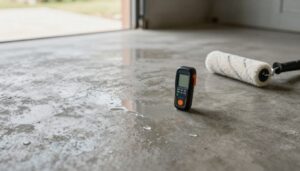
Before installing a new flooring system, the existing concrete needs to be evaluated.
Cracks, joints, moisture concerns, surface deterioration, contamination, and other conditions can influence preparation and system selection.
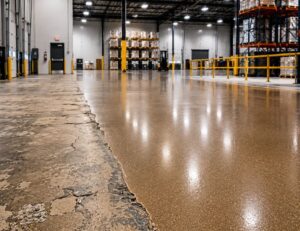
A new coating shouldn’t simply be viewed as a way to hide an underlying concrete problem.
If your floor already shows significant wear, Broadleaf’s guide to signs a commercial concrete floor needs restoration or resurfacing can help identify issues worth investigating.
How to Choose Between Epoxy and Polished Concrete
There is no universal winner between epoxy and polished concrete.
Instead, compare them against the requirements of your specific warehouse.
Think about how much traffic the facility receives, what types of vehicles use the floor, whether chemicals or oils are present, how frequently the floor is cleaned, the appearance you want, and the condition of the existing concrete.
Broadleaf’s broader guide to choosing commercial flooring for high-traffic areas can help facility managers evaluate those priorities.
For warehouses specifically, Broadleaf also provides warehouse epoxy flooring in Chicago and commercial flooring solutions throughout its service area.
Build Your Warehouse Floor Around How Your Facility Actually Operates
The best warehouse floor isn’t simply the system with the most impressive specification sheet.
It’s the floor that fits the facility.
Traffic, chemicals, equipment, moisture, cleaning procedures, existing concrete, safety requirements, and downtime all need to be considered before selecting a system.
Broadleaf works with commercial and industrial facilities to identify flooring solutions suited to real operating conditions. If you’re planning a warehouse flooring project, contact Broadleaf to discuss your facility and the demands placed on its floors.
Key Takeaways
- Warehouse flooring should be selected according to actual operating conditions.
- Epoxy can provide a durable, cleanable surface for many commercial and industrial applications.
- Polished concrete can be an attractive option when the existing slab and facility conditions make it appropriate.
- Urethane cement may be worth considering for more demanding environments.
- Shipping and receiving areas can require special attention because of concentrated traffic and exposure.
- Safety striping and graphics can be incorporated into a larger warehouse flooring strategy.
- Existing concrete should be evaluated before a new flooring system is installed.
- The right warehouse floor balances durability, safety, maintenance, downtime, and long-term performance.